
Why Trump wants Greenland
 First published in spiked, Jan 2026

Washington is desperate to keep Russia and China out of the Arctic
‘Do you know what’s going on in Donald Trump’s head… Is he detached from reality?’, asked Channel 4 News presenter Cathy Newman this week. Certainly, The Donald’s threats to buy or invade Greenland have been theatrical, bombastic and outrageous – even by his standards. Yet there is far more to this Greenland gambit than the president’s personality, ego or mental state.
Nor can Trump’s designs on Greenland be reduced to a desire to grab its raw materials. Washington certainly is interested in many of those, which include not just rare-earth minerals, but also uranium, lithium and – important in modern weapons – gallium, germanium and graphite. At present, America buys most of these from the Chinese Communist Party. Moreover, the CCP’s restrictions on exports of graphite, relaxed for the moment, are set to be reintroduced in late November. No wonder the Pentagon, in particular, is interested in Greenland.
Yet the fact is that cold, inhospitable Greenland – complete with tricky geology, stormy winters and almost no infrastructure – is far from ideal territory for miners of raw materials. To quote the founder of the Arctic Institute, a security think-tank, ‘You might as well mine on the Moon. In some respects, it’s worse than the Moon.’ It takes, on average, 16 years’ expenditure to take a mine in Greenland from idea to results – and, last year, only one mine there was operational.
So what is America’s desire for one of the world’s largest islands really all about? The answer is that, although Greenland’s raw materials are important, the US is principally concerned about keeping Russia, China and Europe out of the Arctic.
The US administration’s National Security Strategy provides a useful insight here. Published in December, it talks of restoring ‘American preeminence in the Western Hemisphere’, and protecting ‘our homeland and our access to key geographies throughout the region’. It then immediately follows this statement with: ‘We will deny non-Hemispheric competitors the ability to position forces or other threatening capabilities, or to own or control strategically vital assets, in our Hemisphere’ (my emphasis). As Frank Furedi has pointed out, the original doctrine of US President James Monroe from 1823, invoked once again by Trump, was to keep Europe out of Latin America. In today’s much more globalised world economy, it’s not just Europe, but also Russia and China that America wants out of its so-called sphere of influence. Taking control of the Arctic plays a major role in this strategy.
After all, Greenland and the Arctic sit above the whole Earth, not just the Western Hemisphere. This whole region forms a nexus of routes for Russian and Chinese missiles and trade freighters. Here, too, sea power is critical, as are undersea cables and drones. Moscow’s permanent Arctic fleet at Murmansk includes 41 icebreakers, which is 41 more than America has (some of the Kremlin’s are nuclear-powered, too). In warships, the CCP has a significant lead over the US Navy, both in numbers and the freshness of its fleet. Annexing Greenland, then, is for Washington not some Trumpian whim, but an imperative.
But why go for complete annexation? Greenland is already home to a US military site, the Pituffik Space Base. Cooperation over Pituffik between the US and Denmark, which manages Greenland’s security, has so far run smoothly. Copenhagen is open to Washington bolstering the military forces stationed in Greenland. A US occupation of Greenland is not needed, either for Trump’s ‘Golden Dome’, a putative system of US defence against incoming missiles, or for protection against naval threats such as Russian submarines.
This leads us to the US’s other geopolitical motivation – dealing with the Old World powers of Europe. As Brendan O’Neill has pointed out, Trump has used Greenland to let the world know that ‘after decades of living like welfare queens off of America’s military largesse’, Europe and Britain are impotent. Washington is furious with European leaders, as demonstrated by its anger towards its European NATO allies over their unwillingness to pay for their own defence.
Last week, in a truly performative and inane pushback against Trump, Europe sent some Danish, German and French troops, plus a single British officer, to conduct and reinforce military exercises in Greenland. This enraged Washington, which took it as a confrontational rather than conciliatory move. In response, it threatened tariffs of 10 per cent on the exports of those countries involved in the exercises, rising to 25 per cent in June.
The minuscule military resources Europe committed to Greenland were always going to irritate rather than impress Trump, let alone intimidate him. Even the EU’s counter-tariffs proposal against the US – worth some $100 billion – has only underscored Europe’s weakness. Indeed, it is now the subject of considerable debate in Brussels, with EU members like Netherlands, Ireland and even Germany voicing caution. Despite their lofty rhetoric, the Europeans are rarely unified and capable of acting in concert.
America’s desire to conquer Greenland is not just about the whims of The Donald, nor even what lies under the ice there. Its considerations are truly strategic. It is about keeping Russia and China out. And in calling time on Europe, Washington has also started to relieve itself of what it deems an unreliable ally. What’s happening over Greenland has consequences for the entire world.
Photo: File ID 354123265 | © Ifeelstock | Dreamstime.com
Innovators I like

Robert Furchgott – discovered that nitric oxide transmits signals within the human body

Barry Marshall – showed that the bacterium Helicobacter pylori is the cause of most peptic ulcers, reversing decades of medical doctrine holding that ulcers were caused by stress, spicy foods, and too much acid

N Joseph Woodland – co-inventor of the barcode

Jocelyn Bell Burnell – she discovered the first radio pulsars

John Tyndall – the man who worked out why the sky was blue

Rosalind Franklin co-discovered the structure of DNA, with Crick and Watson

Rosalyn Sussman Yallow – development of radioimmunoassay (RIA), a method of quantifying minute amounts of biological substances in the body

Jonas Salk – discovery and development of the first successful polio vaccine

John Waterlow – discovered that lack of body potassium causes altitude sickness. First experiment: on himself

Werner Forssmann – the first man to insert a catheter into a human heart: his own

Bruce Bayer – scientist with Kodak whose invention of a colour filter array enabled digital imaging sensors to capture colour
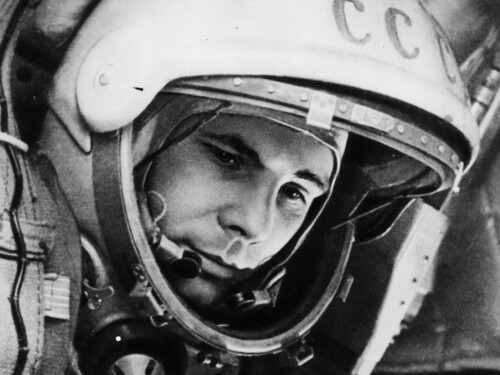
Yuri Gagarin – first man in space. My piece of fandom: http://www.spiked-online.com/newsite/article/10421

Sir Godfrey Hounsfield – inventor, with Robert Ledley, of the CAT scanner

Martin Cooper – inventor of the mobile phone

George Devol – 'father of robotics’ who helped to revolutionise carmaking

Thomas Tuohy – Windscale manager who doused the flames of the 1957 fire

Eugene Polley – TV remote controls
0 comments