
The Trump-Xi summit was about one thing: Taiwan
 First published in spiked, September 2026

Forget AI and trade, the potential for military conflict is what’s preoccupying the two superpowers
It wasn’t by accident that one of the first things Chinese president Xi Jinping heard when he touched down in Washington on Thursday was the deafening roar of two B-1 bombers. A message, we can assume, from the man standing at the other end of the guard of honour gathered at the base of Xi’s plane – US president Donald Trump. Forget AI, trade or the panda bears at the Atlanta zoo, the bombers implied. The summit between the two world leaders was always going to be about one thing: a potential military conflagration over the future of Taiwan.
Nevertheless, in the run-up to Thursday’s summit, news outlets repeated the same error they did the last time Trump and Xi met in May – namely, putting the fate of the small democratic nation below issues such as trade. This time, it was as though the meeting between the two leaders was nothing but an AI safety summit.
Of course, it would have been impossible to keep AI off the agenda. Xi said something about the need to ensure AI ‘is always under human control and serves the wellbeing of the people’. But his more important point was to hint that, should Washington intervene to defend Taiwan from Beijing, both the US and China would ‘lose in confrontation’.
We should never misjudge the weight that the Chinese Communist Party assigns to capturing Taiwan compared with all its other goals. Of course, there are plenty of tensions over trade. And an even bigger issue is AI. But even this, too, comes back to Taiwan.
Indeed, it is becoming increasingly clear that the issues of AI and Taiwan are inextricably linked – particularly from an American perspective. Most of the chips that America’s Nvidia designs are made by the Taiwan Semiconductor Manufacturing Company (TSMC) in north-eastern Taiwan. Even when TSMC makes chips in the US, as the company agreed to do in January, it still packages them up in Taiwan. Meanwhile, Taiwanese electronics assembler Foxconn is set to pour $20 billion into developing a 280-hectare site near Wroclaw, south-west Poland, to make AI servers and parts for electric vehicles. That Taiwan continues to be underplayed in so many ‘analyses’ of the China-US relationship speaks to the kind of ignorance Brits are getting used to with Ed Miliband as their foreign secretary.
All that said, the public needs to keep the issue of competition AI in perspective. The Financial Times, in a typically catastrophist mood, has worried that ‘agreeing on ways to slow the development of cutting-edge models – however desirable – is likely to be the most contentious issue between Washington and Beijing’.
This is wrong. Certainly, when asked by US Big Tech to slow down the development of AI, the Trump administration’s answer ‘is that China should be forced to slow down instead’. Yet, while there was no obvious blowout between Xi and Trump over Taiwan, the island’s fate is likely to prove much more combustible than disputes over Large Language Models.
A far more important question is this. Why, by contrast with his first term, has Trump handled China with such kid gloves in his second? In May, Trump broke precedent and discussed arms sales to Taiwan with Xi. A truce in the trade war between the two nations appears to be holding – at least for now. Nor has China’s imports of Iranian oil, or its willingness to give both Tehran and Moscow a free pass for their military adventures in the Middle East and Ukraine, disturbed Sino-American relations. And why the aerial flypasts, the ridiculous pageantry put on at the White House for the most recent visit?
For right-wing Trump critic and columnist Gerard Baker, it is ‘not unreasonable’ to believe that Trump’s would-be bromance with Xi exists because the latter ‘sits at the very pinnacle of the authoritarian leaders he seems to admire so much’. That old psychobabble again. On the other hand, the Democratic Party sages in Foreign Policy argue that Xi has the upper hand – principally because Trump ‘failed to meaningfully reduce the US economy’s supply-chain dependencies on China’, particularly when it comes to rare earths. Or as another article in Foreign Policy said: ‘Xi comes to Washington armed with a rare-earth card.’
Yet we can be sure that just as China has found workarounds to beat US tactics with chips, the US will find similar lash-ups for its supply of rare earths. In fact, Baker’s article is on firmer ground when he notes that Trump’s continual concessions to Beijing could be ‘purely tactical, designed to buy time so the US can reassert its supremacy’.
A final point, unremarked on in much of the commentary on the summit, is Beijing’s renewed animosity toward Japan. China has been more furious than usual with its historic adversary ever since November, when Japanese PM Sanae Takaichi warned that Japan could get sucked into a war around Taiwan. In a press conference about this week’s summit, Xi’s spokesman protested that Japan’s placing of Typhon missiles on the island of Kyushu was an attempt to ‘expedite remilitarisation’. For good measure, he added that, on the 80th anniversary of the Tokyo War Crimes trials, Japan should ‘do serious research on its history of aggression’. China has also demanded that Takaichi retract her remarks about Taiwan.
At the last summit, Trump intimated that the ‘six assurances’ former US president Ronald Reagan gave Taiwan in 1982 – generally considered to be a pledge to defend the island – were no longer rock-solid. And this year, China’s ‘grey zone’ military pressure on Taipei has intensified.
Like it or not, everything comes back to Taiwan. America knows it. China knows it. Only the mainstream media, as usual, have missed the bleeding obvious.
Photo: File ID 456154530 | © L9871456 | Dreamstime.com
Innovators I like

Robert Furchgott – discovered that nitric oxide transmits signals within the human body

Barry Marshall – showed that the bacterium Helicobacter pylori is the cause of most peptic ulcers, reversing decades of medical doctrine holding that ulcers were caused by stress, spicy foods, and too much acid

N Joseph Woodland – co-inventor of the barcode

Jocelyn Bell Burnell – she discovered the first radio pulsars

John Tyndall – the man who worked out why the sky was blue

Rosalind Franklin co-discovered the structure of DNA, with Crick and Watson

Rosalyn Sussman Yallow – development of radioimmunoassay (RIA), a method of quantifying minute amounts of biological substances in the body

Jonas Salk – discovery and development of the first successful polio vaccine

John Waterlow – discovered that lack of body potassium causes altitude sickness. First experiment: on himself

Werner Forssmann – the first man to insert a catheter into a human heart: his own

Bruce Bayer – scientist with Kodak whose invention of a colour filter array enabled digital imaging sensors to capture colour
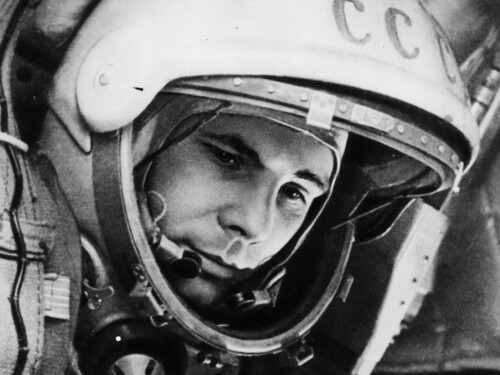
Yuri Gagarin – first man in space. My piece of fandom: http://www.spiked-online.com/newsite/article/10421

Sir Godfrey Hounsfield – inventor, with Robert Ledley, of the CAT scanner

Martin Cooper – inventor of the mobile phone

George Devol – 'father of robotics’ who helped to revolutionise carmaking

Thomas Tuohy – Windscale manager who doused the flames of the 1957 fire

Eugene Polley – TV remote controls
0 comments