
Is DeepSeek AI’s ‘Sputnik moment’?
 First published on spiked, February 2025

The Chinese company’s success has exposed the arrogance of America’s Silicon Valley oligarchs
DeepSeek, a start-up company born in 2023 and based in Hangzhou, China, has announced that it has built an Artificial Intelligence (AI) model at a fraction of the cost of those of the current industry leaders. Indeed, DeepSeek-V3 cost a minuscule $6million of investment rather than the hundreds of millions of dollars that have been ploughed into Sam Altman’s OpenAI, which developed ChatGPT, as well as similar systems at Microsoft, Meta Platforms and Alphabet, the owner of Google.
The whole US stock market suffered as a result of DeepSeek’s success. Shares in Silicon Valley’s Nvidia, which makes most of the chips used by AI, fell in value by 17 per cent. More striking still, it turned out that DeepSeek had found ways of getting hold of Nvidia chips despite longstanding Washington embargoes on militarily useful US technologies going to China. No wonder Donald Trump called DeepSeek’s breakthrough a wake-up call for American AI firms.
Top Silicon Valley venture capitalist Marc Andreessen went further. He called DeepSeek’s achievement AI’s ‘Sputnik moment’. What he meant was that the world of AI, hitherto dominated by the US, had received a shock comparable to that suffered by Washington in 1957, when the Soviet Union put the world’s first satellite into space.
Was Andreessen right? DeepSeek has certainly exposed the fragility of the US stock market, and confirms that the sky-high share price for US AI firms was always ridiculous. But, as ever with IT and AI, it’s vital to avoid both panic and euphoria, and to take a sober, balanced view instead.
As it stands, AI really is not the world-conquering technology some fear or indeed hope it is. Large Language Models (LLMs) like DeepSeek or ChatGPT can effectively regurgitate language in ever more sophisticated ways. But they don’t really grasp the meaning of words, especially their changing meaning, in the way that humans do. Above all, AI does not have agency. It does not plan for the future, it does not will anything at all. Indeed, it doesn’t strive, struggle or dream. And it is certainly not about to cast millions of people out of work, as some have fearfully suggested.
In short, it is not a sign of the post-human future. It is simply an exciting new technology. As such, AI does have its uses. For example, it can help radiographers in the rapid interpretation of X-rays. It can assist with automated administrative tasks. Or help law enforcement detect fraud.
But there are limits to AI’s development that too few are willing to acknowledge. As technology writer Andrew Orlowski has rightly stressed, LLMs are trained using content published online, repurposing and reiterating it. This means that they routinely flout copyright by hoovering up the output of media and creative industries for free. Quite how long this will be allowed to continue is unclear. And it will be up to humans, not AI systems, to decide one way or another.
The development of AI thus far is a testament to our ingenuity as a species. DeepSeek itself certainly shows the superiority of human intelligence over the artificial sort. DeepSeek began as a spinoff from a hedge fund specialised in financial charting. Its founder, Liang Wenfeng, only got into AI out of curiosity. That’s another thing that AI doesn’t have – but, like Silicon Valley, the Chinese do.
DeepSeek’s achievements cannot just be put down to ‘second mover’ advantage – that is, the idea that a company or individual can take advantage of the existing achievements of a pioneer or inventor, while avoiding their missteps. In other words, DeepSeek didn’t achieve its success simply by building on pioneering Silicon Valley coding, copying Western technology or, indeed, purloining Nvidia chips. There is so much more to DeepSeek than that.
Rather, DeepSeek’s success is a tribute to the nature of modern China. The governing Chinese Communist Party (CCP) may be a deeply repressive body. Yet China has not needed democracy or the free market to develop economically and materially, and to make huge technological advances. The CCP’s single-minded pursuit of technological independence and strategic weapons has stimulated some serious innovations in high-speed trains, electric cars, quantum communications and space. DeepSeek is an illustration, then, of China’s model of authoritarian dynamism.
Not that DeepSeek is a perfect piece of AI tech by any means. All LLMs have struggled with so-called hallucinations, whereby they simply make things up that are patently untrue. But this problem is compounded in the case of DeepSeek by the CCP’s proclivity for censorship. So when asked by users about the CCP’s violent suppression of protests at Tiananmen Square, Beijing, in 1989, or indeed about its current treatment of Uyghur Muslims, DeepSeek was unable to generate any answers at all. ‘Sorry, that’s beyond my current scope’, it responded. ‘Let’s talk about something else.’ It shows that the limits of DeepSeek are at points the same as those of the repressive CCP.
Marc Andreessen has called DeepSeek ‘a profound gift to the world’. And the company is certainly a stinging rebuke to the arrogance of Silicon Valley oligarchs. But though its model looks like a big step forward, let’s not go overboard just yet.
Photo: File ID 359384262 | © Su Wei | Dreamstime.com
Innovators I like

Robert Furchgott – discovered that nitric oxide transmits signals within the human body

Barry Marshall – showed that the bacterium Helicobacter pylori is the cause of most peptic ulcers, reversing decades of medical doctrine holding that ulcers were caused by stress, spicy foods, and too much acid

N Joseph Woodland – co-inventor of the barcode

Jocelyn Bell Burnell – she discovered the first radio pulsars

John Tyndall – the man who worked out why the sky was blue

Rosalind Franklin co-discovered the structure of DNA, with Crick and Watson

Rosalyn Sussman Yallow – development of radioimmunoassay (RIA), a method of quantifying minute amounts of biological substances in the body

Jonas Salk – discovery and development of the first successful polio vaccine

John Waterlow – discovered that lack of body potassium causes altitude sickness. First experiment: on himself

Werner Forssmann – the first man to insert a catheter into a human heart: his own

Bruce Bayer – scientist with Kodak whose invention of a colour filter array enabled digital imaging sensors to capture colour
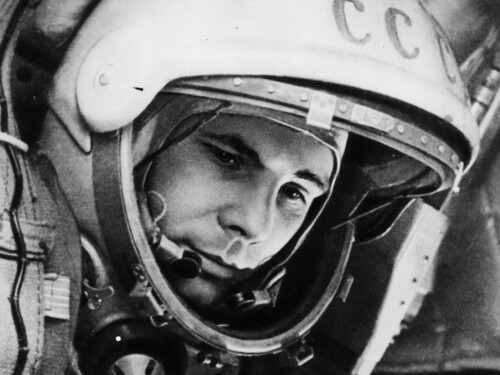
Yuri Gagarin – first man in space. My piece of fandom: http://www.spiked-online.com/newsite/article/10421

Sir Godfrey Hounsfield – inventor, with Robert Ledley, of the CAT scanner

Martin Cooper – inventor of the mobile phone

George Devol – 'father of robotics’ who helped to revolutionise carmaking

Thomas Tuohy – Windscale manager who doused the flames of the 1957 fire

Eugene Polley – TV remote controls
0 comments